
The right business structure for you depends less on your revenue and more on who you deal with. A freelance designer invoicing three clients a month faces a different risk profile than an e-commerce seller holding RM80,000 of inventory, or a trading business signing supplier contracts in US Dollars. Agencies carry contract and liability risk. E-commerce businesses carry inventory and platform risk. Trading businesses carry supplier credit and currency risk. Each of those risks points toward a different answer on whether a sole proprietorship or a limited liability company in Malaysia, known as a Sdn Bhd, makes more sense for you.
🔔 TL;DR
- A sole proprietorship and a Sdn Bhd are not “cheap vs expensive” options. They are different legal structures with different liability outcomes, and your industry changes how much that liability matters.
- Agencies should weigh contract and client-liability exposure. E-commerce businesses should weigh inventory and supplier debt. Trading businesses should weigh currency exposure and large purchase orders.
- A Sdn Bhd gives shareholders limited liability for business debts, while a sole proprietorship leaves the owner personally liable for all business debts and legal obligations.
- Sole proprietorship registration is cheaper and faster to set up than a Sdn Bhd, but it does not separate your personal assets from your business risk.
- Once you’re ready to incorporate, a qualified company secretary in Malaysia handles your SSM company name search, registration and ongoing filings, so you can register a Sdn Bhd in as little as 2 days with Boss Boleh.
📌 What’s the real difference between a sole proprietorship and a Sdn Bhd?
A sole proprietorship is a business registered under your own name or a trade name, with no legal separation between you and the business. A Sdn Bhd is a private limited company, a separate legal entity from its owners, registered under the Companies Act 2016.
That separation is the whole decision in one sentence: in a sole proprietorship, you and the business are the same legal person, so business debts are your personal debts. In a Sdn Bhd, the company can own assets, sign contracts and owe money in its own name. The Companies Commission of Malaysia (SSM) allows a Sdn Bhd to have up to 50 shareholders, and those shareholders benefit from limited liability protection for their personal assets. A sole proprietor has unlimited personal liability for all business debts and legal obligations.
In a sole proprietorship, you carry all business debts as personal debts. In a Sdn Bhd, the company is liable for its own debts first, and your personal assets are generally shielded, as long as you haven’t personally guaranteed something or acted negligently.
📌 Why does an agency’s risk profile point toward incorporating?
Agencies (marketing, design, consulting, IT services) run on contracts, not inventory. The main risk isn’t stock going bad, it’s a client suing over a missed deadline, a botched campaign or a data breach caused by your team.
If you’re a sole proprietor and a client claims damages because your agency’s error cost them business, that claim can reach your personal savings, your car, even your house, because there’s no legal wall between you and the business. A Sdn Bhd puts that wall up. The company’s contracts are the company’s contracts, and your personal assets are generally shielded, unless you personally signed a guarantee.
Agencies also tend to scale through bigger clients over time, corporate clients, government tenders, multinational accounts. Many of these clients have an internal policy of only contracting with Sdn Bhd entities, since a registered company has public records on SSM and a traceable Beneficial Owner (BO) structure. If you’re pitching for five-figure retainers, being a Sdn Bhd can be the difference between making the shortlist and not even being considered.
📌 Why does e-commerce change the calculation?
E-commerce businesses hold something agencies usually don’t: physical inventory, often bought on credit from suppliers before it’s sold. That changes your risk from “a client sues me” to “I can’t pay a supplier, or a product causes harm.”
If a batch of skincare products you imported and resold causes an allergic reaction, or a supplier you owe RM50,000 to comes after you for non-payment after a bad sales season, a sole proprietorship structure means that debt and that claim are yours personally. A Sdn Bhd caps that exposure at what the company owns, generally speaking.
E-commerce sellers also deal with marketplaces and payment gateways that increasingly ask for company registration documents to access higher transaction limits or official store badges. Incorporating early, before you’re forced to scramble for documents mid-growth, tends to save founders a lot of friction later.
📌 Why do trading businesses usually need the Sdn Bhd structure sooner?
A trading business buys and resells goods, often across borders, often in bulk, often on payment terms. That means bigger numbers moving through the business earlier than in an agency or a small e-commerce store. Signing a purchase order for a container of goods, negotiating supplier credit terms in foreign currency, or taking on a bank trade-financing facility all involve the business owing real money to other parties.
A sole proprietorship can get a trade financing facility, but you personally guarantee it, and a slow shipment or a currency swing can turn into a personal debt overnight. A Sdn Bhd lets the company hold that exposure, and banks and suppliers are generally more comfortable extending credit terms to a company with its own SSM registration, Annual Return history and audited or unaudited financial statements, rather than to an individual.
📌 How do the setup cost and time actually compare?
Registering a Sole Proprietorship costs significantly less than registering a Sdn Bhd and is typically processed much faster. SSM’s statutory incorporation fee for a Sdn Bhd has stood at RM1,000 since the Companies Act 2016 and its regulations took effect, and that fee still applies in 2026, on top of whatever service fee your company secretary charges. A sole proprietorship’s registration cost is a fraction of that.
Speed follows the same pattern: sole proprietorship registration is close to instant, while Sdn Bhd incorporation takes a few working days once your documents and name search are in order. Boss Boleh can incorporate a Sdn Bhd in as little as 2 working days, the fastest standard turnaround offered by any Malaysian provider.
| Factor | Sole Proprietorship | Sdn Bhd |
| Legal identity | Same as the owner | Separate legal entity |
| Liability | Unlimited, personal | Limited to company assets, generally |
| Registration cost | Lower | RM1,000 statutory fee plus service fees |
| Setup time | Faster | A few working days (2 days with Boss Boleh) |
| Tax treatment | Progressive personal income tax, up to 30% | Tiered corporate tax rates |
| Annual filings | Business registration renewal only | Annual Return, financial statements, BO reporting |
| Company secretary required | No | Yes, within 30 days of incorporation (Companies Act 2016, Section 236(2)) |
📌 What compliance work comes with the Sdn Bhd structure, regardless of industry?
Whichever industry you’re in, choosing a Sdn Bhd means taking on a set of fixed obligations that a sole proprietorship doesn’t have. Under the Companies Act 2016, every Sdn Bhd must appoint at least one qualified company secretary in Malaysia within 30 days of incorporation (Section 236(2)). The secretary supports your statutory registers, resolutions and SSM filings, but compliance stays a shared responsibility between the company, its directors and the secretary.
SSM mandates that an Sdn Bhd lodge its Annual Return generally within 30 days of its incorporation anniversary (Section 68), and lodge financial statements after they’re circulated to members (Section 259). A sole proprietorship only renews its business registration, with no financial statements to prepare or lodge.
Audit is a related but separate question. Under the Companies Act 2016, a Sdn Bhd may file Unaudited Financial Statements if certain criteria are met (Section 366). Owners still need to appoint an auditor unless an exemption applies, and the exemption doesn’t remove the need for a company secretary or proper accounting records.
LHDN also requires sole proprietorships to keep accurate bookkeeping records for 7 years, so “simpler structure” doesn’t mean “no record-keeping”. Both structures must register for the Sales and Service Tax (SST) once they cross the mandatory revenue threshold, and tax treatment diverges sharply from there: sole proprietors are taxed at progressive personal income rates up to 30%, while a Sdn Bhd is taxed under tiered corporate tax rates.
📌 Frequently Asked Questions
Can I start as a sole proprietor and convert to a Sdn Bhd later?
Yes. Many agencies, online sellers and trading businesses start as a sole proprietorship and convert once revenue, client size or supplier risk grows. The conversion involves incorporating a new Sdn Bhd and transferring the business over, it isn’t an automatic upgrade of the existing registration.
Does a Sdn Bhd protect me if I personally guarantee a loan?
No. If you sign a personal guarantee for a company loan or supplier credit line, that guarantee follows you personally, regardless of the company’s limited liability status.
Do I need a company secretary if I run a one-person Sdn Bhd?
Yes. Every company incorporated under the Companies Act 2016, including a one-shareholder Sdn Bhd, must appoint at least one qualified company secretary (Section 235). A sole proprietorship doesn’t need one.
How do I check if a company name is available before I register?
You run an SSM company name search through SSM’s official channels or through your company secretary, before locking in branding, packaging or domain names.
Is a Sdn Bhd always more expensive to run than a sole proprietorship?
Setup and compliance costs are generally higher for a Sdn Bhd because of statutory fees, annual filings and potential audit costs. Whether that cost is worth it depends on how much personal liability you’re carrying as a sole proprietor, which is exactly the industry-specific question this article walks through.
Can a foreigner register a Sdn Bhd for an e-commerce or trading business in Malaysia?
Yes. Foreigners can incorporate a Sdn Bhd in Malaysia, though the appointed company secretary must be an eligible individual meeting the Companies Act 2016’s residency and qualification requirements, even if a corporate secretarial firm is engaged to support the process.
ABOUT BOSS BOLEH
Boss Boleh is an online company secretary and incorporation platform built for first-time entrepreneurs across agencies, e-commerce and trading businesses weighing the switch from sole proprietorship to Sdn Bhd. Beyond company secretarial work, it also offers a one-stop compliance solution for entrepreneurs, including accounting, tax planning and tax filing services. We handle SSM company name searches, 2-working-day incorporation, Annual Return and Beneficial Owner submissions, and standard corporate resolutions for banking and company changes, so you can focus on running your agency, store or trading operation instead of chasing paperwork.
References
You’re welcome to join our community group to get exclusive and latest trend of business insight!
Want to learn more about managing your business structure the right way? 💼
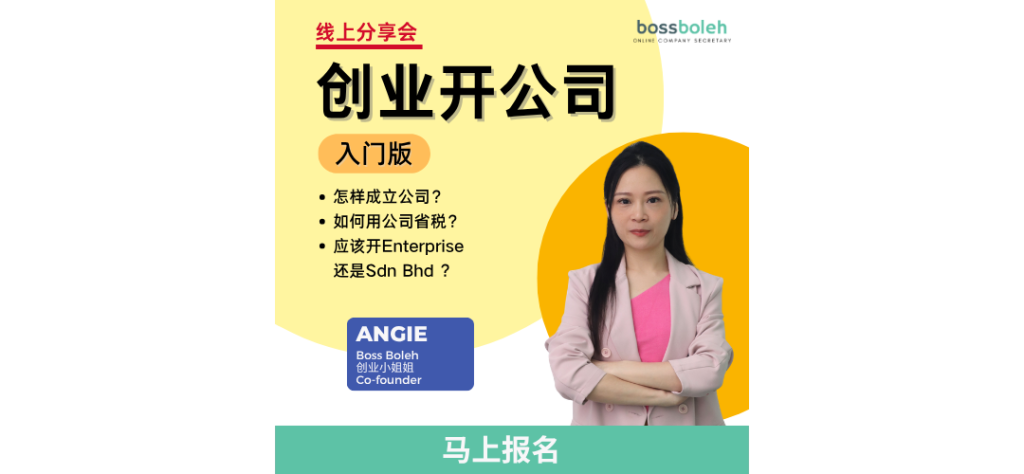
Join our FREE webinar! We’ll walk you through compliance essentials and how to convert from Enterprise to Sdn Bhd with confidence.
For more details, feel free to WhatsApp us!
📲 WhatsApp: 018-7678055
 1,500+ reviews with a 4.9-star rating on