
A compliance study plan is a short, structured list of topics you learn in order, over 4 to 6 weeks, so that by the time you incorporate your Sdn Bhd (private limited company), you already know what SSM (Companies Commission of Malaysia), LHDN (Inland Revenue Board), and your company secretary expect from you. You don’t need a law degree. You need to learn five things in sequence: what a Sdn Bhd actually is, what a company secretary does, your filing calendar, your tax and payroll calendar, and what happens if something is missed. Most first-time founders try to absorb all of this in a panic, usually right before a deadline. Building a plan up front is faster and a lot less stressful.
🔔 TL;DR
- Spread your compliance learning across 5 modules: company structure, company secretary basics, SSM filings, tax and payroll, and audit exemption rules.
- Learn the real deadlines first: Annual Return within 30 days of your incorporation anniversary, Financial Statements within 30 days of circulation to members, and Beneficial Owner updates within 14 days of any change.
- A missing or resigned company secretary does not pause these deadlines. Directors stay responsible either way.
- Audit exemption under the Companies Act 2016 only affects whether your financial statements need a full audit. It doesn’t remove your filing or secretary obligations.
- Free resources (webinars, WhatsApp support, BB School) can replace a paid company secretary course for most first-time founders.
📌 Why should a first-time founder build a study plan instead of just winging it?
Building a plan matters because compliance in Malaysia isn’t one event, it’s a calendar. You incorporate once, but you file Annual Returns every year, update Beneficial Owner (BO) information whenever ownership changes, and submit Financial Statements within a fixed window after your financial year ends. If you only learn these rules reactively, one at a time, as each deadline approaches, you’re more likely to miss one. A study plan front-loads the learning so you’re never caught off guard. Think of it the way you’d study for a driving test: you don’t learn the highway code the night before, you learn it in modules, then practice. Compliance works the same way, except the “test” repeats every year.
📌 What should Module 1 of your compliance study plan cover?
Module 1 should answer one question clearly: Sdn Bhd vs enterprise, which one are you actually running, and why does it matter? An enterprise (sole proprietorship) is registered under your own name or a business name, with no separate legal identity from you. A Sdn Bhd is a separate legal person under the Companies Act 2016, which is why it needs its own secretary, its own filings, and its own bank account. Spend this module understanding:
- How liability differs: as a sole proprietor, your personal assets are exposed to business debts; in a Sdn Bhd, liability is generally limited to what you’ve invested.
- Why banks, investors, and some clients prefer dealing with a Sdn Bhd, especially for equipment financing, franchise agreements, or grant applications.
- Why conversion from enterprise to Sdn Bhd is common once profit grows past a point where the tax and credibility benefits outweigh the extra compliance work.
If this module raises more questions than it answers, that’s normal. It’s exactly what a free “Enterprise vs Sdn Bhd” webinar is designed to walk through, step by step, with real numbers.
📌 What should Module 2 cover: company secretary requirements in Malaysia?
Module 2 should teach you exactly who can be your company secretary and why the role exists at all. Under Section 235 of the Companies Act 2016, every Sdn Bhd and Berhad must appoint at least one qualified company secretary. “Qualified” means one of two routes: either membership of a recognised professional body (such as MAICSA or MIA), or a qualification route recognised by SSM [Section 235]. Either way, the person must also register with SSM and hold a valid practising certificate under Section 241. A few things to know here:
- The secretary must be a natural person, not a company, aged at least 18, and ordinarily resident in Malaysia (so a foreign-owned Sdn Bhd still needs an eligible individual appointed, even if a secretarial firm is doing the work).
- A director CAN also serve as company secretary, as long as they meet the qualification requirements, register with SSM, and hold a valid practising certificate. Section 242 only restricts this for actions that legally require a director and a secretary to be different people.
- The board must appoint the first secretary within 30 days of incorporation [Section 236(2)]. Failing to do so is an offence under Section 236(4).
- If a secretary resigns, the position can’t stay vacant for more than 30 days [Section 240] before a replacement is appointed.
Appointing a secretary doesn’t take compliance off your plate entirely. The company and its directors keep their own duties under the Act; the secretary supports statutory registers, resolutions, and SSM filings alongside you.
📌 What should Module 3 cover: the SSM filing calendar?
Module 3 is where most of your actual annual workload lives, so learn this calendar cold. Here’s the sequence:
| Filing | Deadline | Governing Section |
| Annual Return (SSM) | Generally within 30 days of incorporation anniversary | Section 68 |
| Financial Statements | Generally within 30 days of circulation to members, unless an extension is approved | Section 259 |
| Beneficial Owner (BO) update | Within 14 days of any change in beneficial ownership, confirmed annually via e-BOS | SSM’s Beneficial Ownership framework |
| Secretary appointment notice | Within 14 days of appointment | Section 58 |
Miss these and you’re looking at two separate kinds of cost. SSM applies tiered late-lodgement penalties, generally ranging from RM50 to RM200 per document depending on how overdue it is. Separately, a court may impose a fine of up to RM50,000 upon conviction against the company and any officer who contravenes Section 68 for Annual Returns, or up to RM50,000 upon conviction under Section 259 for Financial Statements, plus in some cases up to RM1,000 per day the offence continues after conviction. These are maximums a court may impose upon conviction, not automatic bills, but they show why the filing calendar deserves a full module of its own.
📌 What should Module 4 cover: tax and payroll obligations?
Building on the SSM calendar above, Module 4 shifts you from SSM’s world to LHDN’s and the payroll bodies’. This is where founders new to Malaysia often feel lost, so keep it simple:
- CP204: your estimate of tax payable, submitted to LHDN, determining your monthly tax instalments.
- Form C: your company’s annual income tax return.
- Form E and EA: annual employer and employee tax reporting if you hire staff.
- KWSP (Employees Provident Fund) and PERKESO (Social Security Organisation): mandatory monthly contributions once you have employees.
- PCB (monthly tax deduction): tax withheld from employee salaries and remitted to LHDN.
- HRDC (Human Resources Development Corporation) levy: applies to employers in certain sectors, based on headcount and payroll size.
- SST (Sales and Service Tax): applies once your business crosses the relevant registration threshold for taxable goods or services.
Note that your own external tax agent or accountant can handle most of this, and nothing stops you from keeping the one you already trust.
📌 What should Module 5 cover: audit exemption and when you still need to appoint an auditor?
A related but distinct question from the filing calendar is whether your financial statements need a full audit. Smaller Sdn Bhd companies may qualify not to file a full audit under the Companies Act 2016, and instead file Unaudited Financial Statements (UAFS) through MBRS. Two things are easy to misunderstand here:
- Whether an audit is required affects only the financial statements themselves. It does not remove your need for a company secretary, proper accounting records, or lodging financial statements on time.
- If you don’t qualify for exemption, you still need to appoint an external auditor and file the audited financial statements. This is a separate step from anything your company secretary does.
📌 Frequently Asked Questions
Is there a proper “company secretary course” a founder should take?
You don’t need a professional qualification course, that’s for people becoming company secretaries themselves. As a founder, free resources like webinars, BB School, and a provider’s knowledge base cover what you actually need to know.
What happens if my company secretary resigns or goes quiet?
Deadlines keep running and directors stay responsible for the company’s obligations. The work becomes harder without an active secretary, so you’ll want a replacement appointed within the 30-day window under Section 240.
Can I just handle compliance myself without any company secretarial services?
No. Every Sdn Bhd must have at least one qualified company secretary under Section 235; this isn’t optional, even for a one-person company.
Where do I check if someone is actually qualified to be my company secretary?
SSM maintains a List of Registered Secretaries. Ask for the person’s name, practising certificate number and validity, and their professional body membership or registration details with SSM.
Does a company secretary in Kuala Lumpur work differently from one elsewhere in Malaysia?
No, the legal requirements are the same nationwide. Boss Boleh serves first-time entrepreneurs across Kuala Lumpur, every other state, and Malaysians living overseas equally.
Can a director also be the company secretary?
Yes, as long as they meet the qualification requirements, register with SSM, and hold a valid practising certificate. Section 242 only restricts this where an action needs a director and a secretary to be different people.
ABOUT BOSS BOLEH
Boss Boleh is a licensed company secretary and online incorporation platform built for first-time entrepreneurs and first-time Sdn Bhd owners working through exactly the kind of study plan above. Beyond company secretarial work, it also offers a one-stop compliance solution for entrepreneurs, including accounting, tax planning and tax filing services. We handle Annual Return and Beneficial Owner submissions to SSM, provide standard corporate resolutions for director changes and share allotments, and incorporate a new Sdn Bhd in 2 working days. Clients can keep their own external auditor or tax agent, open a company bank account without visiting a branch, and get WhatsApp support throughout. With over 1,500 Google reviews at a 4.9-star average, Boss Boleh also runs a free “Enterprise vs Sdn Bhd” webinar for founders still mapping out their own compliance calendar.
References
- Companies Act 2016 (Act 777), sections 58, 68, 235, 236, 240, 241, 242, 259, 267
You’re welcome to join our community group to get exclusive and latest trend of business insight!
Want to learn more about managing your business structure the right way? 💼
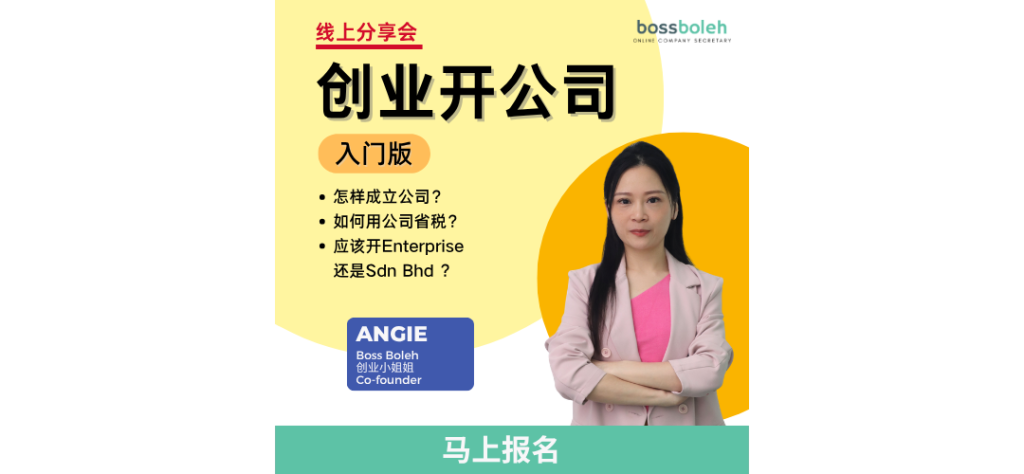
Join our FREE webinar! We’ll walk you through compliance essentials and how to convert from Enterprise to Sdn Bhd with confidence.
For more details, feel free to WhatsApp us!
📲 WhatsApp: 018-7678055
 1,500+ reviews with a 4.9-star rating on