What must a new Malaysian SaaS (software as a service) startup have ready before its first customer signs up? You need five things in place:
- a privacy notice in Bahasa Melayu and English
- a way to record consent
- basic security and retention rules
- a breach response plan
- a named person who owns data protection
Why start at incorporation? Once your Sdn Bhd (private limited company) exists, it is the company that collects personal data. So the duties under the Personal Data Protection Act 2010 (PDPA) sit with the company. The first 30 days after incorporation is already when your board must appoint its company secretary (Section 236(2)). That makes it the natural time to settle data protection too.
📌 What are the key points?
- That puts PDPA work on the board’s first to-do list.
- The PDPA’s seven principles cover consent, notice, disclosure, security, retention, data integrity and access.
- Under the Personal Data Protection Commissioner’s guidelines, you must report a qualifying breach within 72 hours. You must appoint a data protection officer once you pass the Commissioner’s thresholds, such as personal data of more than 20,000 individuals or financial data of more than 10,000 individuals.
- Your company secretary supports your Companies Act work. PDPA duties stay with the company and its directors.
This article is general information, not legal advice.
📌 Why does PDPA compliance start at incorporation, not at product launch?
PDPA duties sit with whoever controls how the personal data is processed. From incorporation day, that is your company.
- The Act applies to processing personal data in respect of commercial transactions [Personal Data Protection Act 2010, Section 2].
- Personal data means any information relating directly or indirectly to an identifiable individual [Personal Data Protection Act 2010, Section 4]. For a SaaS startup, that covers sign-up emails, staff records and payment details.
- Once SSM (the Companies Commission of Malaysia) incorporates your Sdn Bhd, the company signs your customer terms. That makes it the data user.
- A pre-launch waitlist form already collects personal data.
The same window carries a company law duty. Every company must have at least one qualified company secretary (Section 235). The board must appoint the first one within 30 days of incorporation (Section 236(2)). In practice, your first board meeting is already on the calendar, so add data protection to the agenda.
Action: list every form and tool that will collect personal data before launch.
📌 What does the Personal Data Protection Act ask a SaaS startup to do?
Once you know what data you collect, the Act tells you how to handle it through seven principles.
| Principle (PDPA section) | What it means for your SaaS |
|---|---|
| General (6) | Get consent before processing |
| Notice and Choice (7) | Tell users what you collect and why, in Bahasa Melayu and English |
| Disclosure (8) | Do not share data for purposes users were not told about |
| Security (9) | Protect data from loss, misuse or unauthorised access |
| Retention (10) | Delete data once you no longer need it |
| Data Integrity (11) | Keep data accurate and up to date |
| Access (12) | Let users see and correct their data |
Two more documents fill in the detail:
- Consent records: consent must be in a form that can be recorded and maintained [Personal Data Protection Regulations 2013, Regulation 3]. For a SaaS product, keep a log of each consent checkbox and its timestamp.
- Minimum standards: minimum standards apply for security, retention and data integrity. These cover electronic and paper records.
📌 Is your SaaS a data user, a data processor, or both?
A related but distinct question is whose data you are holding.
- Data user: you collect the data for your own purposes, such as account emails and billing.
- Data processor: you process data your business customers upload, on their behalf.
Most B2B (business-to-business) SaaS startups are both. The 2024 amendments extended the Security Principle to data processors [Personal Data Protection Act 2010, Section 9]. In practice, your customer contracts should state what you do with uploaded data.
📌 When do you need a data protection officer?
Building on the processor question, the next issue is volume.
A data protection officer (DPO) is the person your company appoints to oversee PDPA compliance. You need one if your company processes personal data of more than 20,000 individuals, or sensitive personal data (including financial information) of more than 10,000 individuals, among other criteria in the Commissioner’s guideline [Personal Data Protection Act 2010, Section 12A]. This matters if your founders live overseas.
Worked example: your SaaS has 8,000 users in month 6 and adds 2,500 a month.
- Month 11: 8,000 + (2,500 × 5) = 20,500 users
🔔 QUICK TAKE AWAY
You cross 20,000 in month 11, so choose your DPO by month 9. If you hold users’ financial information, the 10,000 threshold may apply sooner. Count individuals, not paying accounts. One client with 300 staff logins means 300 individuals.
📌 What happens if your startup has a data breach?
Volume also raises the stakes when something goes wrong. Under the Commissioner’s guidelines:
- Notify the Commissioner within 72 hours of a qualifying breach [Personal Data Protection Act 2010, Section 12B].
- Notify affected individuals if the breach causes significant harm.
A company that breaches a data protection principle may face a fine upon conviction. Directors and managers can also be held personally liable for an offence committed by the company [Personal Data Protection Act 2010, Section 133].
Action: write a one-page breach plan. Name who decides, who notifies and who updates the register.
📌 PDPA vs GDPR: which one applies to your SaaS?
A breach plan may need to meet two laws if you sell overseas.
- PDPA: Malaysian law for personal data processed in commercial transactions.
- GDPR (General Data Protection Regulation): EU law. It can apply to a business outside the EU that offers goods or services to people in the EU.
- Breach reporting: GDPR also expects regulator notification within 72 hours where feasible.
Our view: if EU users are in your plan, build your consent and deletion features to meet both laws from the start. Changing them later means reworking a live product.
📌 What should a SaaS founder put in place before the first customer?
Putting it together, here is the order we suggest:
- Incorporate your Sdn Bhd so the company is the contracting party. We can set it up in 2 days, fully online with eKYC (electronic identity checks) and digital signatures.
- Appoint a qualified company secretary within 30 days of incorporation (Section 236(2)). The secretary supports statutory registers, resolutions and SSM filings. Directors keep their own duties.
- Map your data: each field, why you collect it, where you store it and how long you keep it.
- Publish a bilingual privacy notice and log consent.
- Set security and retention rules against the 2015 Standard.
- Write your breach plan and open a breach register.
- Name a data protection owner now, and appoint a formal DPO before you reach the threshold.
For privacy notices and customer contracts, ask a data protection lawyer. For company secretarial and incorporation questions, WhatsApp us or join our free webinar on converting from Enterprise to Sdn Bhd.
📌 Frequently Asked Questions
Does the PDPA apply before I have paying customers?
It can. A waitlist collecting names and emails for your product is safest treated as covered.
Can a company secretary in Malaysia also be our DPO?
They are separate roles under separate laws. Check that the person meets the DPO guideline before giving them both jobs.
Is an English-only privacy notice enough?
No. The notice must be in Bahasa Melayu and English.
What does Section 235 of the Companies Act require?
Every company must have at least one qualified company secretary. That is a separate duty from the PDPA.
Does Boss Boleh handle PDPA compliance?
No. We handle incorporation, company secretarial work, accounting and tax. A data protection lawyer should review your PDPA policies.
ABOUT BOSS BOLEH
Boss Boleh is an online company secretary and incorporation platform built for first-time entrepreneurs and tech and AI startups preparing for their first customers. Beyond company secretarial work, it also offers a one-stop compliance solution for entrepreneurs, including accounting, tax planning and tax filing services. We can set up your Sdn Bhd in 2 working days, fully online with eKYC and digital signatures, and open your company bank account with no branch visit. Our subscription plans cover Annual Return and Beneficial Owner submissions to SSM and standard resolutions such as director changes and share allotments, with WhatsApp support throughout. With over 1,500 Google reviews at a 4.9-star average, Boss Boleh is trusted by founders across Malaysia.
References
- Companies Act 2016 (Act 777), sections 235 and 236(2)
- Personal Data Protection Act 2010 (Act 709), sections 2, 4, 6 to 12, 12A, 12B and 133
- Personal Data Protection (Amendment) Act 2024 (Act A1727)
- Personal Data Protection Regulations 2013, regulation 3
- Personal Data Protection Standard 2015, and the Personal Data Protection Commissioner’s guidelines on data protection officers and data breach notification
- Regulation (EU) 2016/679 (General Data Protection Regulation), Articles 3(2) and 33
You’re welcome to join our community group to get exclusive and latest trend of business insight!
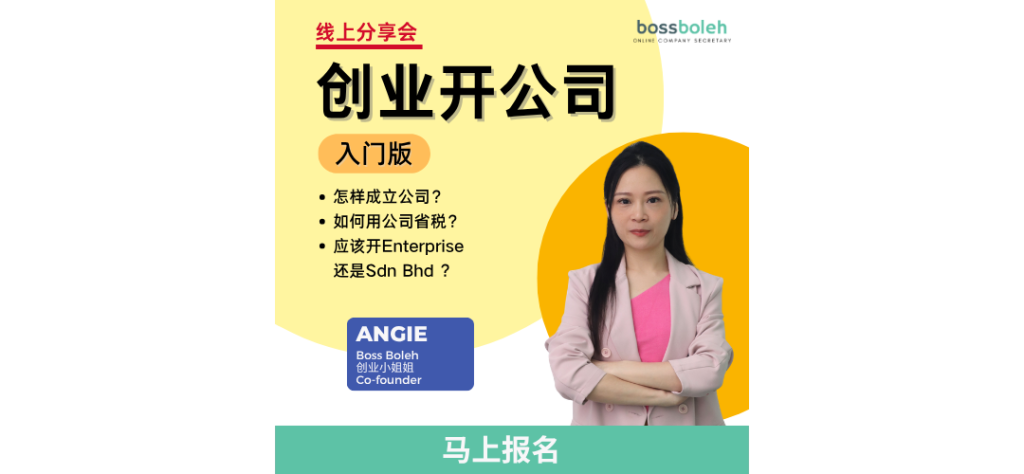
Want to learn more about managing your business structure the right way? 💼
Join our FREE webinar! We’ll walk you through compliance essentials and how to convert from Enterprise to Sdn Bhd with confidence.
For more details, feel free to WhatsApp us!
📲 WhatsApp: 018-7678055
 1,500+ reviews with a 4.9-star rating on